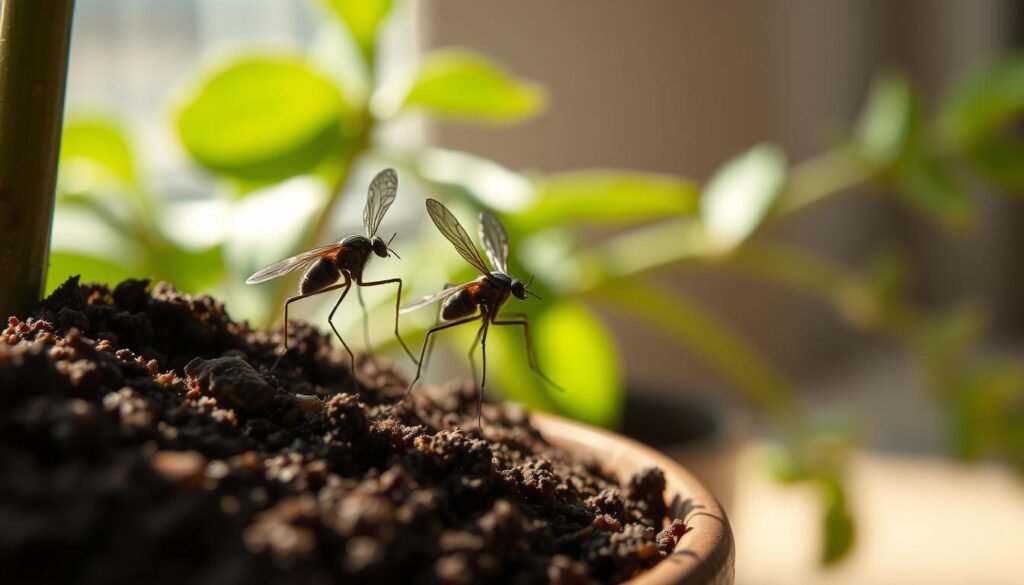

Surprising fact: Nearly one in five houseplant owners report seeing tiny mosquito-like pests around pots each year. That can feel overwhelming, but this guide will show you how to stop annoying flying gnats now and break the breeding cycle in your soil.
Quick note: Those tiny, leggy flies are mostly a nuisance, yet their larvae live in damp potting soil and can feed on organic matter and young roots. That risk is greatest for seedlings and young plant growth.
Why the problem seems endless: Swatting adults helps, but eggs and larvae remain tucked inside the mix. To clear an infestation, you must treat adults and the soil at the same time.
This guide sticks to gentle, home-friendly methods. You’ll learn how to confirm an infestation, reduce moisture, trap flying adults, treat larvae in the soil, and prevent a repeat. Most steps focus on moisture control and targeted treatments rather than harsh chemicals.
Key Takeaways
- Act fast: treat both adults and larval stages for best results.
- Cut excess moisture; damp soil invites breeding.
- Use traps for flying pests while treating the potting mix.
- Targeted, low-toxicity options protect seedlings and mature plants.
- Follow a step-by-step plan: confirm, reduce moisture, trap, treat, prevent.
Spotting Fungus Gnats and Confirming an Infestation in Houseplants
A quick look at where tiny flying pests hang out helps you spot an infestation fast. Watch body shape and behavior for clear clues before you treat every pot.
Visual clues: Mini mosquito-like adults are skinny, leggy, and long-legged. Fruit flies are rounder and more tubby. If you see tiny, hovering bugs resting on pot rims or popping up from the soil surface when you water, suspect the potting mix rather than a bowl of fruit.
Simple potato slice test
Place raw potato slices flat on the surface and check after 4–8 hours. Larvae will cling beneath the slice if they are present. The larvae are pale, about 5 mm, with a darker head — not just harmless bits of soil.
Why they seem to follow you
Adults often fly toward your face because they track carbon dioxide from your breath. Even one or two visible ones can mean eggs are in the soil. Try to identify the source pot before treating everything; that saves time and keeps unaffected pots alone.
Why Fungus Gnats Show Up in Indoor Plants
Most outbreaks start with soil that stays wet and warm for days on end. Warm, moist soil creates perfect conditions where decay and fungi flourish. Larvae feed on organic matter and young roots, so rich mixes can be a banquet when the mix stays damp.
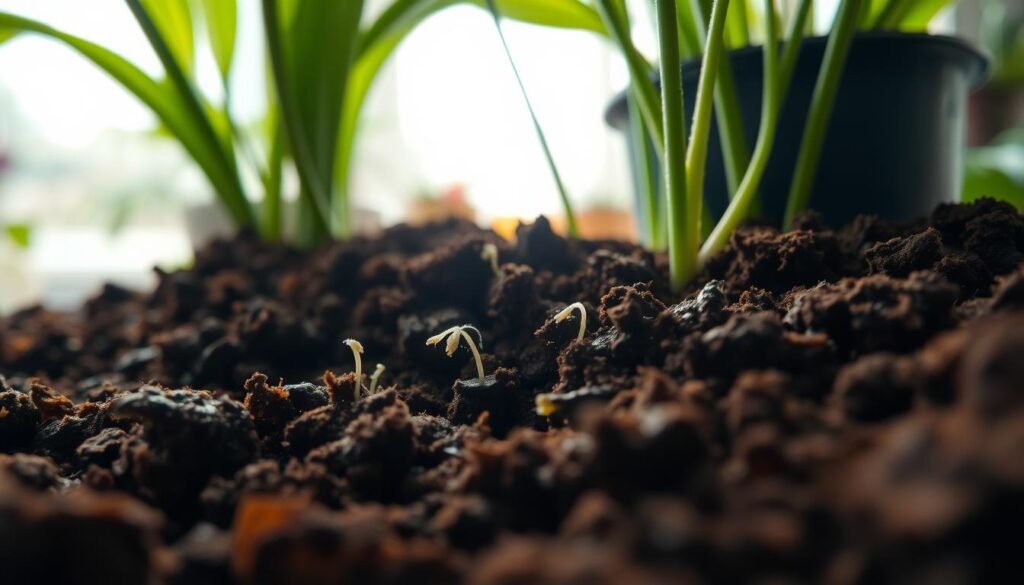
Warm, moist soil and high organic matter
Short answer: gnats love warm, moist soil because it supports fungus and decaying organic matter.
High organic matter means more food for larvae when the soil stays wet. That raises the risk of fast infestations during warmer months.
Overwatering and poor airflow
Overwatering is the most common accidental invitation. Pots that don’t dry—due to low airflow or crowded groupings—stay attractive to adults and larvae.
New purchases and stored mix
New plants and bagged soil can carry eggs or tiny larvae. Quarantine new additions for at least 2 weeks, ideally 4, before adding them to your main garden.
| Cause | Why it helps pests | Quick fix | When it speeds up |
|---|---|---|---|
| Moist soil | Supports decay and fungus | Let top 1–2 inches dry | Warm weather |
| High organic matter | More food for larvae | Use leaner mixes or add perlite | Fresh potting mixes |
| New pot or soil | May contain eggs | Quarantine 2–4 weeks | Stored outdoors or warm storage |
| Poor airflow | Soil stays damp longer | Space pots and boost circulation | Crowded shelves |
Understanding the Fungus Gnat Life Cycle to Break It Fast
Knowing where each life stage hides inside a pot lets you target treatments precisely. That clarity makes control faster and more effective.
Where each stage lives
Eggs and larvae live in the top layer of soil or potting mix. Pupae stay deeper in the mix, and adults fly above the surface.
Why populations explode so quickly
An adult can lay about 200–300 eggs. In warm conditions the full life cycle can finish in ~17 days. More commonly it takes ~3 weeks in summer and 4–5+ weeks when it’s cooler.
What larvae do and why that matters
Larvae eat decaying matter and can nibble delicate roots. Heavy numbers slow growth and harm plant roots, especially in seedlings.
“Even a few flying adults can seed a major population if eggs and larvae remain in the soil.”
Strategy that works: attack adults with traps while treating the soil for larvae. That dual approach stops new eggs from being laid and removes the next generation at the same time.
- Stage map: eggs/larvae = soil; pupae = potting mix; adults = flying above the pot.
- Expect repeat checks over several life cycles—consistency wins with time.
fungus gnats in indoor plants how to get rid of
Start by moving any affected pots away from healthy ones. Isolation stops adults from spreading eggs to nearby soil and gives you a clear treatment zone.
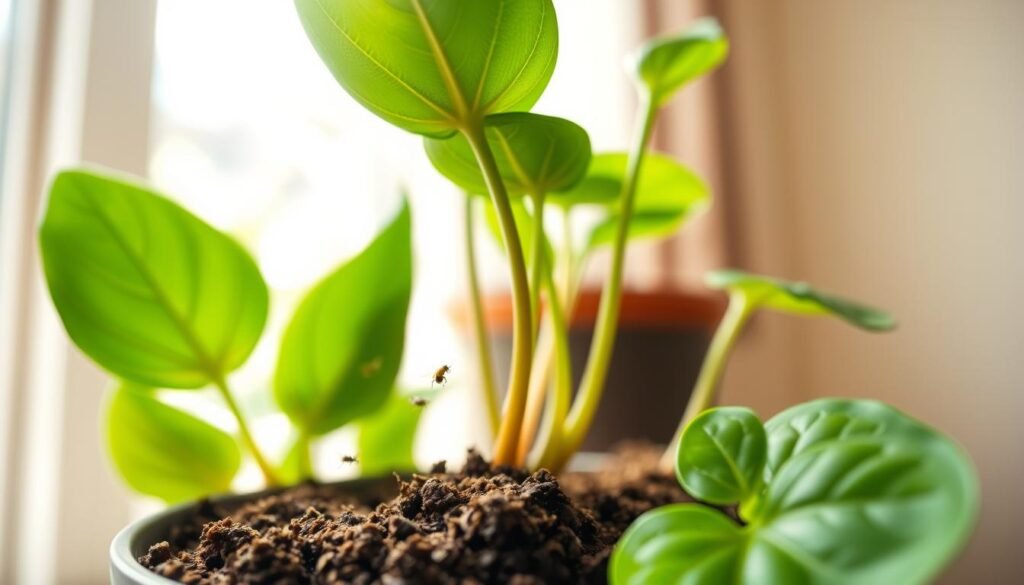
Containment and a clear plan
First move: isolate the source, then follow a repeatable routine.
- Cut moisture: let the top 1–2 inches of soil dry.
- Place sticky traps near the soil surface to catch adult gnats and reduce breeding.
- Treat the soil for larvae with a BTI drench or another low-toxicity option.
- Repeat treatments through at least 1–2 life cycles (4–8 weeks).
When you can’t find the source pot
Treat nearby plants or your whole shelf if the breeding pot is unclear. That way you avoid missing eggs hiding in another mix.
“Hit adults and larvae at once — it’s the fastest way to stop an infestation from restarting.”
| Action | Target | Expected time |
|---|---|---|
| Sticky traps | Adult gnats | Fewer in days |
| BTI soil drench | Larvae and eggs | 4–8 weeks |
| Repeat checks | All life stages | Longer in winter, faster in summer |
Realistic timeline: you may see fewer adults quickly, but full elimination often takes weeks. In winter, expect slower progress. The best way to get rid is a combined approach that treats both adults and larvae together.
Moisture Control That Makes Soil Inhospitable to Gnats
Drier soil makes a pot far less welcoming. Small changes to how you water can change the microclimate and stop breeding cycles.
Let the top layer dry before you water again
Rule of thumb: check that the top 1–1.5 inches of soil feel dry before you water plants. That depth helps ensure the surface zone where larvae live is less favorable.
Speed drying with airflow and pot choice
Boost airflow with a small fan or an open window and space pots apart. A dehumidifier or warm grow light can cut dry time.
Tip: terracotta pots wick moisture and often dry faster than plastic pots.
Top watering vs bottom watering during treatment
Larvae concentrate near the top ~5 cm, so top watering helps deliver treatments to the surface layer where they work best.
Bottom watering can work if you continue long enough that the top layer becomes wet too. Otherwise, it may miss larvae.
- Define “let it dry out”: top 1–1.5 inches should be dry.
- Why it works: removing damp conditions stops eggs and larvae from thriving.
- Speed tips: fan, spacing, dehumidifier, terracotta.
Caution: don’t force drought stress on sensitive plant ones; adjust dry time by species and monitor for stress.
Traps That Cut Down the Adult Gnat Population
Catching adults with simple traps reduces the number of eggs laid and gives other treatments a head start. Traps are a quick, visible step you can take while you adjust watering and treat the soil.
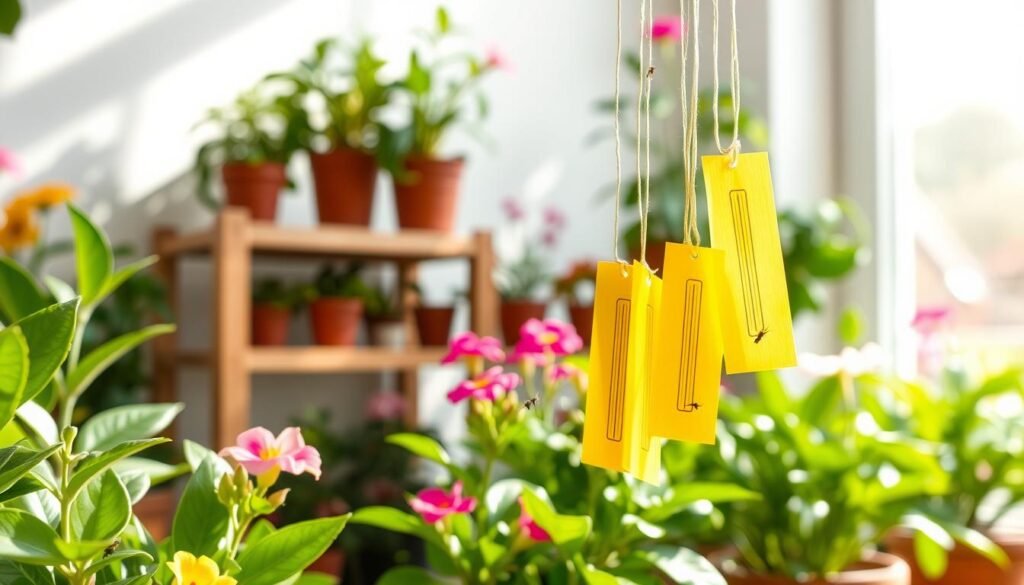
Sticky traps: placement close to the soil surface for best catches
Sticky traps work best when placed just above the soil surface where adults hover. Position small yellow or blue cards a few inches from each pot rim.
Use multiple traps for crowded shelves and replace them when dusty or full. This cuts adult numbers fast and lowers how many eggs get laid.
Apple cider vinegar trap with dish soap
Make a simple vinegar trap: pour apple cider vinegar in a shallow bowl or jar and add a couple drops of dish soap. The soap breaks surface tension so flies sink and drown.
Optionally cover with plastic wrap and poke holes to increase captures. Vinegar attracts adults but does not affect larvae under the soil surface.
When traps help most and why they can’t solve larvae alone
Traps reduce the breeding population, but they do not reach eggs or larvae in the mix. For full control, pair traps with moisture control and a larval soil drench.
| Trap type | Target | Best placement |
|---|---|---|
| Sticky traps | Adult | Close to soil surface, near pot rim |
| Vinegar bowl | Adult | On shelf near affected pots |
| Plastic-wrap vinegar | Adult | Indoor bench, replace every few days |
Soil Treatments That Target Larvae and Protect Plant Roots
Targeted soil treatments stop larvae underground before they damage roots. These solutions focus on the top layer where young stages live and where they do most feeding.
BTI “mosquito bits” drench
BTI (Bacillus thuringiensis israelensis) is the go-to indoor larval treatment. Make a simple “mozzie tea”: soak ~4 tbsp of bits in 1 gallon of warm water for 30–60 minutes, let cool, strain out granules, then top water so the drench wets the surface where larvae feed.
Hydrogen peroxide as a knockdown
As an alternate, dilute 1 part 9% H2O2 to 6 parts water. Pour slowly; you may see brief fizzing as it breaks down to oxygen and water. Use this occasionally—it’s a quick knockdown but not a long-term solution.
Neem, biopesticides, and nematodes
Neem oil mixed per label directions can disrupt life cycles and deter adults when applied to the top soil layer.
Ready-made biopesticide drenches offer indoor-friendly options—always follow label and ventilate if directed.
For stubborn infestations, beneficial nematodes work well if soil temps are 60–90°F and slightly moist. Apply at the recommended time for best results.
“Hit the surface zone where larvae concentrate and protect roots while you treat.”
| Treatment | Targets | Best use |
|---|---|---|
| BTI drench | larvae | Regular weekly drench until clear |
| H2O2 dilute | larvae | Quick knockdown; occasional use |
| Nematodes | larvae | Stubborn cases; correct temps |
Natural and Pantry Methods: Helpful Add-Ons (and Their Limits)
Everyday household items offer gentle ways to reduce food sources at the soil surface. These are useful as extras, not stand-alone cures.
Cinnamon and chamomile tea
Cinnamon is a mild natural fungicide. Sprinkle a light dusting on the surface to slow decay and cut the tiny fungi that larvae feed on.
Chamomile tea can be brewed strong, cooled, diluted, and used as a light surface drench during normal watering if your plants tolerate it.
Potato slices as a progress check
Lay raw slices flat for a few hours, then check the underside for larvae. Heavy infestations often show feeders within 4–8 hours.
“Pantry fixes reduce food sources and help you measure progress — they rarely finish the job alone.”
| Method | Works on | Best use | Limit |
|---|---|---|---|
| Cinnamon | surface fungus | Sprinkle light layer | Slow acting |
| Chamomile tea | surface microbes | Dilute drench with watering | May need repeat |
| Potato slices | larvae detection | Progress meter (4–8 hrs) | Removes few larvae vs eggs |
Bottom line: use these as support alongside BTI, neem, peroxide, and traps. Track fewer larvae on potato and fewer adults on traps over time to judge success.
When Repotting and Soil Changes Make Sense
Repotting is often the fastest way to reset soil that stays soggy or smells musty.
Signs you need fresh mix: the surface stays wet for days, the potting mix crumbles into fine particles, or the pot smells sour. These signs mean organic matter is breaking down and can feed larvae and eggs that keep an infestation alive.
How to repot without spreading pests to your home
Work over a trash bag, gently remove the old mix, and discard it outdoors. Clean the pot and saucer with soapy water before adding fresh mix.
Root care and pot choice
Avoid heavy root damage; trim only clearly rotten roots. Choose a well-draining mix and a pot with drainage holes to help roots dry between waterings.
Top-dressing barriers and limits
Sand, gravel, or pebbles on the top surface can block adults from laying eggs. They also slow evaporation if layered too deep, so use a thin layer and pair the barrier with a larval drench like BTI and sticky traps for a full solution.
- Make sure you don’t reuse contaminated soil indoors.
- Make sure tools and saucers are rinsed well.
- Make sure the plant is stable after repotting.
| When | Action | Benefit |
|---|---|---|
| Soil stays soggy | Repot with well-draining mix | Faster drying, healthier roots |
| Mix breaks down | Replace top or full mix | Less organic matter for larvae |
| Active infestation | Combine repotting with treatments | Stops eggs and larvae cycle |
Conclusion
A steady, combined approach is the fastest path back to calm pots and clear air. Make the surface less inviting, catch adults with traps, and treat larvae in the soil across one to two life cycles.
Why it works: fungus gnats persist because multiple stages live at once. Targeting adults and larvae together breaks the cycle and speeds recovery.
Be patient: you may see fewer gnats quickly, but full control takes consistent action over time. Expect faster results in warm months and slower progress in cooler weather.
Quick prevention checklist: water only when needed, boost airflow, clear decaying debris, and quarantine new plants. Protect the root zone and avoid stressing the plant while you treat.
Stick with the plan through the full cycle and your pots will settle down—no more gnats hovering at the soil line.