

Have you ever noticed your prayer plant’s leaves pointing towards the ceiling in the evening, as if in prayer, only to see them relaxed and open again the next morning? Or perhaps you’ve seen the delicate petals of a flower you brought inside gently fold inward as dusk settles. It’s a subtle daily dance that many plant owners observe with curiosity. The first time you see it, you might even worry that something is wrong with your plant. But this behavior is not a sign of distress; it’s one of the most fascinating processes in the plant world, a natural rhythm as old as life itself.
My name is Kamil Khan, and for years, my passion has been exploring and writing about the captivating world of indoor flowers. My journey started not in a formal laboratory, but with a single, fussy Calathea on my windowsill. Watching it raise and lower its leaves with the sun sparked a deep curiosity that has led me to study the science and behavior of countless houseplants. Through years of hands-on observation and research, I’ve learned to interpret the subtle signals our plants send us. My goal is to share that knowledge, helping you understand the “why” behind your plant’s behavior so you can build a more intuitive connection with your green companions.
Understanding Nyctinasty: The Official Term for Plant Sleep
This phenomenon of plants closing up at night and opening during the day has a scientific name: nyctinastic movement. Let’s break that down. “Nyctinasty” comes from the Greek words nux, meaning “night,” and nastos, meaning “pressed close.” It refers to a plant’s rhythmic, non-growth movement in response to the daily cycle of light and darkness. It’s a planned, deliberate action controlled by the plant’s internal biological clock, much like our own sleep-wake cycle.
It’s important to distinguish this from other plant movements. For instance, phototropism is when a plant slowly bends or grows towards a light source, like a sunflower tracking the sun. Nyctinasty isn’t about growth; it’s a reversible, daily repositioning of leaves or petals.
So, why do they do it? Botanists have several compelling theories, and the answer is likely a combination of these evolutionary advantages.
- Energy Conservation: Keeping leaves and petals held open requires energy. By closing up at night when photosynthesis is on pause, the plant can conserve precious resources for growth and blooming during the daylight hours.
- Protection from the Elements: In the wild, nighttime can bring cooler temperatures and dew. Closing up can protect the plant’s delicate reproductive organs—the pollen and stigma—from getting too cold or damp, ensuring they are viable for pollinators the next day.
- Pest Deterrence: Some researchers believe that the upward movement of leaves makes the plant less appealing or accessible to certain nocturnal crawling insects, reducing the chances of being eaten.
- Water Regulation: The movement can help the plant manage water loss. By reducing the surface area exposed to the air overnight, the plant can minimize transpiration, which is the process of water vapor escaping from the leaves.
Nyctinasty vs. Phototropism: A Quick Comparison
To make the distinction clear, here’s a simple comparison between these two common plant movements.
| Feature | Nyctinastic Movement (Plant Sleep) | Phototropism (Light Seeking) |
| Trigger | The daily cycle of light to dark (internal clock). | Directional light source. |
| Purpose | Conservation, protection, water regulation. | Maximizing light exposure for photosynthesis. |
| Movement Type | Reversible, daily folding/unfolding. | Slow, directional growth or bending. |
| Speed | Relatively fast; can be observed over hours. | Very slow; often noticeable over days or weeks. |
| Example | A prayer plant lifting its leaves at night. | A houseplant leaning towards a window. |
The Internal Clock: How Your Plants Tell Time
How does a plant, without a brain or nervous system, know when it’s time to close up shop for the night? The secret lies in a sophisticated internal mechanism known as a circadian rhythm. This is a built-in, roughly 24-hour biological clock that governs a host of processes in nearly all living things, from humans feeling sleepy at night to plants opening their flowers in the morning.
This internal clock doesn’t just react to light; it anticipates it. I’ve seen this in my own collection. Even if a room is kept artificially dark, a healthy prayer plant will still begin to open its leaves around the time the sun would normally rise. This shows that the rhythm is ingrained in the plant’s biology.
The key to this system is specialized proteins called photoreceptors. You can think of these as the plant’s “eyes.” The two main types involved are:
- Phytochromes: These receptors are sensitive to red and far-red light. They essentially tell the plant whether it’s in direct sun, shade, or darkness, helping it track the time of day and even the season.
- Cryptochromes: These receptors are sensitive to blue light. They work alongside phytochromes to help regulate the circadian clock and other light-dependent processes.
When the sun begins to set, the quality and quantity of light changes. The phytochromes and cryptochromes detect this shift and send a signal throughout the plant, essentially telling its cells, “Okay, it’s time to start the nighttime routine.” This message kicks off the physical mechanism that causes the leaves and petals to move.
The Mechanics of Movement: Turgor Pressure and the Pulvinus
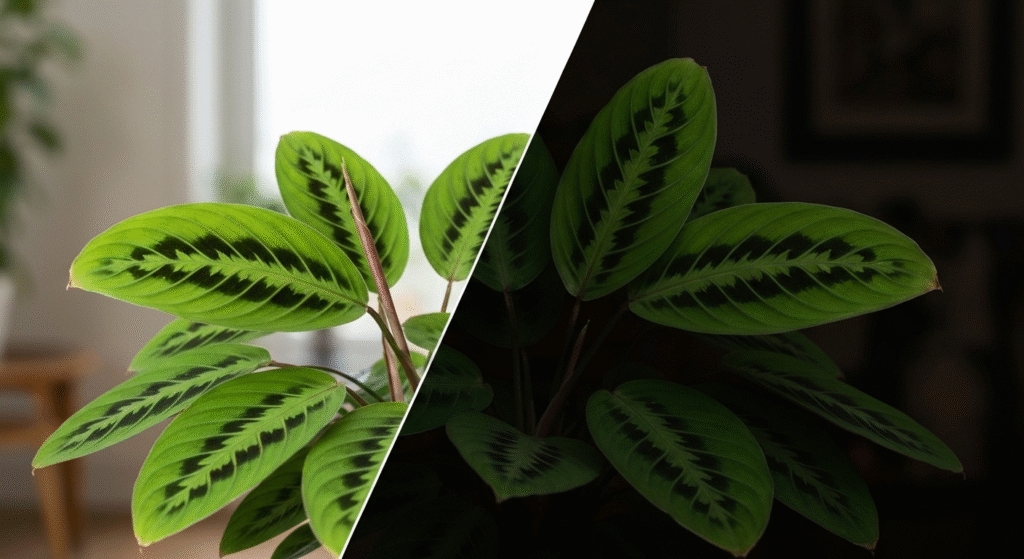
The actual movement of the leaves and petals is a marvel of natural engineering. It isn’t caused by muscles, but by a clever hydraulic system. At the base of the leaf or petal of a nyctinastic plant, there is a specialized, joint-like structure called a pulvinus. This little organ acts as the engine for the plant’s movement.
The movement itself is powered by changes in turgor pressure. In simple terms, turgor pressure is the force of water pushing against the inside of a plant’s cell walls. When a cell is full of water, it is turgid and firm. When it loses water, it becomes flaccid and limp. The pulvinus contains specialized cells that can rapidly pump water in or out.
Here’s how it works, step-by-step:
- Dusk Arrives: As evening approaches, the photoreceptors signal the pulvinus to begin the closing process.
- Ion Pumping: Cells on one side of the pulvinus (the “extensor” region) begin to actively pump potassium ions out.
- Water Follows: Through the process of osmosis, water naturally moves from an area of low ion concentration to high ion concentration. As ions leave the cells, water follows them out, causing these cells to lose turgor pressure and become flaccid.
- Movement Occurs: As one side of the pulvinus goes limp, the other side (the “flexor” region) remains turgid and firm. This difference in pressure creates a lever action, causing the leaf or petal to fold upward or downward.
- Dawn Reversal: In the morning, the process reverses. The cells pump potassium ions back in, water rushes back into the cells, turgor pressure is restored, and the leaf or petal opens back up to greet the day.
Day vs. Night Action in the Pulvinus
| Time of Day | Ion Movement | Turgor Pressure in Extensor Cells | Leaf/Petal Position |
| Daytime | Potassium ions pumped into cells. | High (Turgid) | Open/Lowered |
| Nighttime | Potassium ions pumped out of cells. | Low (Flaccid) | Closed/Raised |
Common Houseplants That “Sleep” at Night
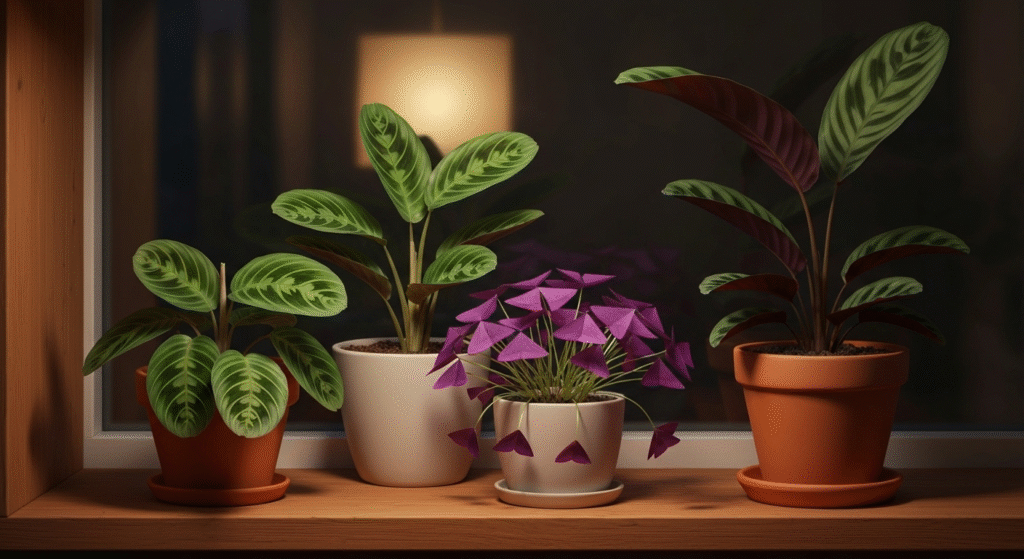
While this behavior is fascinating, not all houseplants do it. It is a specific trait found in certain plant families. If you want to witness this daily rhythm in your own home, these are some of the best plants to observe.
The Prayer Plant Family (Marantaceae)
This is the most famous group of nyctinastic plants. The name “prayer plant” comes directly from this behavior. Their leaves lie relatively flat during the day to absorb light and then fold up vertically at night, resembling hands in prayer. Some of the most popular varieties include:
- Maranta leuconeura (Red Prayer Plant): Known for its dramatic upward folding.
- Calathea varieties: Many species, like the Rattlesnake Plant and Zebra Plant, exhibit stunning leaf movements.
- Stromanthe Triostar: Its beautiful pink, green, and cream leaves also rise at night.
The Oxalis (Shamrock Plant)
The Oxalis triangularis, often called the Purple Shamrock, is another classic example. During the day, its three triangular leaflets are held open and horizontal. At night, they fold down neatly, looking like a small closed umbrella. The movement is so precise and noticeable that it’s a joy to watch.
Other Notable Examples
While less common or dramatic, other plants show subtle nyctinastic movements.
- Some Begonias: Certain species may lower their leaves slightly at night.
- African Violets: The flowers of some varieties can close slightly in the dark.
- Legumes: Many plants in the legume family, like beans and clover, fold their leaves at night. While not typically grown as flowering houseplants, the principle is the same.
Table of “Sleeping” Houseplants
| Plant Name | Family | Characteristic Movement |
| Prayer Plant (Maranta) | Marantaceae | Leaves fold upward like praying hands. |
| Calathea (various species) | Marantaceae | Leaves rise vertically or fold together. |
| Shamrock Plant (Oxalis) | Oxalidaceae | Three leaflets fold downward like an umbrella. |
| Stromanthe Triostar | Marantaceae | Leaves rise vertically, showing off pink undersides. |
Observing Your Plant’s Rhythms: What to Look For
Watching your plants move is a rewarding experience that deepens your connection to them. The best way to see it is to pay attention to the plant’s position in the late afternoon and then check on it again a few hours after the sun has set. The change can be surprisingly dramatic. For a fun project, you can use your smartphone’s time-lapse feature. Set it up in front of your prayer plant an hour before sunset and let it run for a few hours to capture the full movement.
What if My Plant Stops Moving?
First, don’t panic. And remember, most plant species don’t exhibit nyctinastic movement at all. If your African Violet isn’t moving, it’s perfectly normal. However, if you have a plant known for this behavior, like a Calathea, and it suddenly stops its daily dance, it could be a sign of stress. Here are a few things that can disrupt the cycle:
- Improper Lighting: The most common culprit. A plant needs a clear distinction between day and night. If it’s under a grow light 24/7 or in a room where the lights are always on, its internal clock can get confused. Ensure it has a consistent period of darkness each day.
- Watering Issues: Both overwatering and underwatering can cause stress that inhibits movement. If the plant doesn’t have the right amount of water available, its ability to regulate turgor pressure in the pulvinus is compromised.
- Low Temperatures: Very cold conditions can make the plant sluggish and prevent it from moving properly.
- Pest Infestations or Disease: If a plant is fighting off pests or a fungal infection, it will divert its energy to survival, and non-essential functions like nyctinastic movement may cease.
If your “sleeping” plant stops moving, check its environment first. In my experience, correcting a lighting or watering issue is usually all it takes to see the beautiful daily rhythm return within a week or two.
Frequently Asked Questions
What time do flowers usually close at night?
This depends on the plant and the time of year, but most nyctinastic plants begin to move around sunset. The process is gradual, often taking one to two hours to complete as the light fades.
Does artificial light stop my plants from closing?
Yes, it can. If a plant is exposed to bright artificial light well into the night, its photoreceptors won’t get the “darkness” signal, which can disrupt its circadian rhythm and prevent it from closing up.
Is it bad if my prayer plant stops “praying”?
It’s not necessarily “bad,” but it is a sign that something in its environment isn’t ideal. It’s the plant’s way of telling you to check its light, water, or overall health. Think of it as an early warning system.
Do all flowers open and close with the sun?
No, not at all. Nyctinastic movement is a special trait found only in certain plant families. Most houseplants, like pothos, monsteras, and philodendrons, do not move their leaves in this way.
Conclusion
The nightly closing of indoor flowers is far from a sign of weakness. It is a sophisticated survival strategy, a demonstration of the plant’s internal clock, and a beautiful example of life’s quiet, constant rhythms. This nyctinastic movement is a testament to how plants actively engage with their environment, conserving energy, protecting themselves, and preparing for the day ahead.
By understanding the science behind why your Calathea’s leaves rise or your Oxalis’s leaflets fold, you move beyond being a simple caretaker and become a more observant, informed plant enthusiast. So next time you see one of your plants closing up for the evening, take a moment to appreciate the silent, intricate dance it performs each day. It’s a gentle reminder that even in the stillest corners of our homes, life is always in motion.